A serviced industrial zone in the heart of Zambia's copper corridor
Kokeb Enterprises is developing a 275-hectare Multi-Facility Economic Zone on its own land between Solwezi and the Kipushi border — a place for the workshops, warehouses, plants and people that the region's mines and the Lobito Corridor now need. We are inviting anchor tenants, co-developers and infrastructure partners to shape it with us from the first phase.
Built where the demand already is
North-Western Province produces most of Zambia's copper. Kansanshi, Lumwana and Sentinel are among the largest mines on the continent, each in the middle of expansion programmes, and a new generation of exploration is under way in Mushindamo District itself. Every one of those operations relies on a supply chain of equipment dealers, engineering contractors, logistics companies and service firms — and almost none of them can find serviced industrial land, bonded storage or decent housing within reach of the mines.
Kokeb has worked in this corridor for years as a contractor, equipment reconditioner and property developer. We have watched suppliers improvise in rented yards on the edge of Solwezi, and we have watched the trucks to and from the Democratic Republic of Congo pass our land on the Kipushi road. The zone is our answer to both: a properly planned, serviced and administered estate that gives the supply chain a permanent base, and gives cross-border trade a bonded, customs-ready stop before the frontier.
The timing is deliberate. Zambia's Investment, Trade and Business Development Act of 2022 gives declared special economic zones a clear licensing route and a schedule of incentives, and the Lobito Corridor programme is drawing new logistics investment into exactly this part of the country. A zone that opens with working tenants, rather than vacant plots, is well placed to benefit from both.
The mining supply chain
Original-equipment service centres, component rebuild shops, fabrication, consumables warehousing and contractor yards serving Kansanshi, Lumwana, Sentinel and the exploration camps of Mushindamo.
Cross-border logistics
The Solwezi–Kipushi Road is the direct route to the Congolese Copperbelt. A bonded terminal and container depot on the road lets freight consolidate, clear and stage before the border.
Value addition
Serviced plots with heavy power and water for mineral beneficiation, building-materials manufacture, agro-processing and assembly — the activities Zambia's industrial policy is designed to reward.
People
Housing, a skills academy and community facilities inside the zone, so that tenants recruit and retain locally instead of flying staff in and out.
On the road between the mines and the border
Solwezi
Provincial capital, airport and the Kansanshi mine, roughly 35 km to the south-west by road. Labour, services and administration are within an easy commute.
Kipushi border
The road past the gate continues north-east to the Kipushi border post and on to Lubumbashi, the commercial centre of the DRC's copper belt — a market of several million people a short drive away.
Lumwana and Kalumbila
Barrick's Lumwana mine and First Quantum's Sentinel and Enterprise operations lie west along the T5 — the corridor along which Kokeb's other land holdings and contracts sit.
Lobito Corridor
The rail and road programme linking the Copperbelt to the Atlantic at Lobito runs through North-Western Province. The zone is positioned to serve the logistics activity it brings.
Mushindamo District
A young district with a supportive administration and an active exploration sector; the zone would be its first planned industrial estate and a significant local employer.
Coordinates
Site centre approximately 12.00° S, 26.60° E (UTM 35S). Open the KMZ in Google Earth to see the boundary over imagery.
Two adjoining sectors, one estate
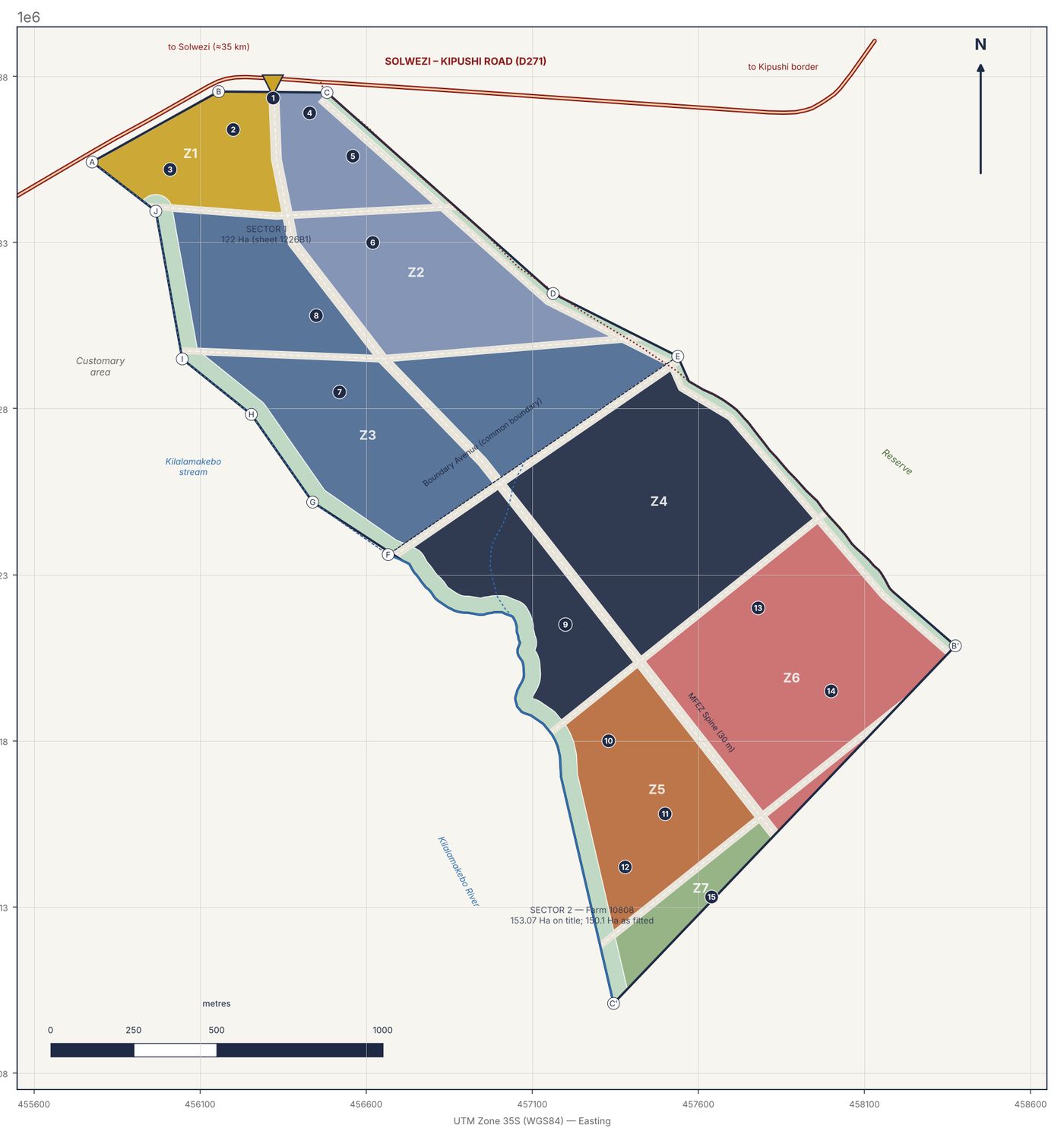
The zone is assembled from two parcels that share a common boundary and together form a single site 2.8 km long and up to 1.2 km wide. Sector 1, the northern parcel of 122 hectares, carries the whole 762-metre road frontage and is where the gate, the commercial centre, the logistics terminal and the first industrial plots will be built. Sector 2, Farm No. 10808, is a 153-hectare titled farm held by Kokeb on a 99-year state lease; it takes the process industry, the utilities, the housing and the land held for expansion.
The site is bounded on three sides by features that give it shape and protection: the public road to the north, a reserve along the eastern track, and the Kilalamakebo River along the entire western edge. The river corridor is reserved as a 50-metre green buffer that doubles as the estate's stormwater system and its recreational spine; the eastern edge carries a perimeter service road and firebreak.
Both parcels are surveyed. Sector 2 is on title; Sector 1 is held under customary tenure with the Chief's endorsement and is in the process of conversion to state leasehold, after which the two will be consolidated into a single title for the zone. We say this plainly because it is the first question serious partners ask, and because the answer is a programme already in motion rather than a hope.
- Sector 1
- 122 ha · road frontage · Phase 1 · conversion to leasehold in progress
- Sector 2
- Farm No. 10808 · 153.07 ha · Certificate of Title 140071 · 99 years from 1 Dec 2022
- Access
- Main gate on the D271 Solwezi–Kipushi Road; secondary access along the eastern track
- Water
- Kilalamakebo River frontage; groundwater for Phase 1
- Terrain
- Gently falling towards the river; topographic and flood-line survey scheduled
Seven zones, graded from the gate to the river
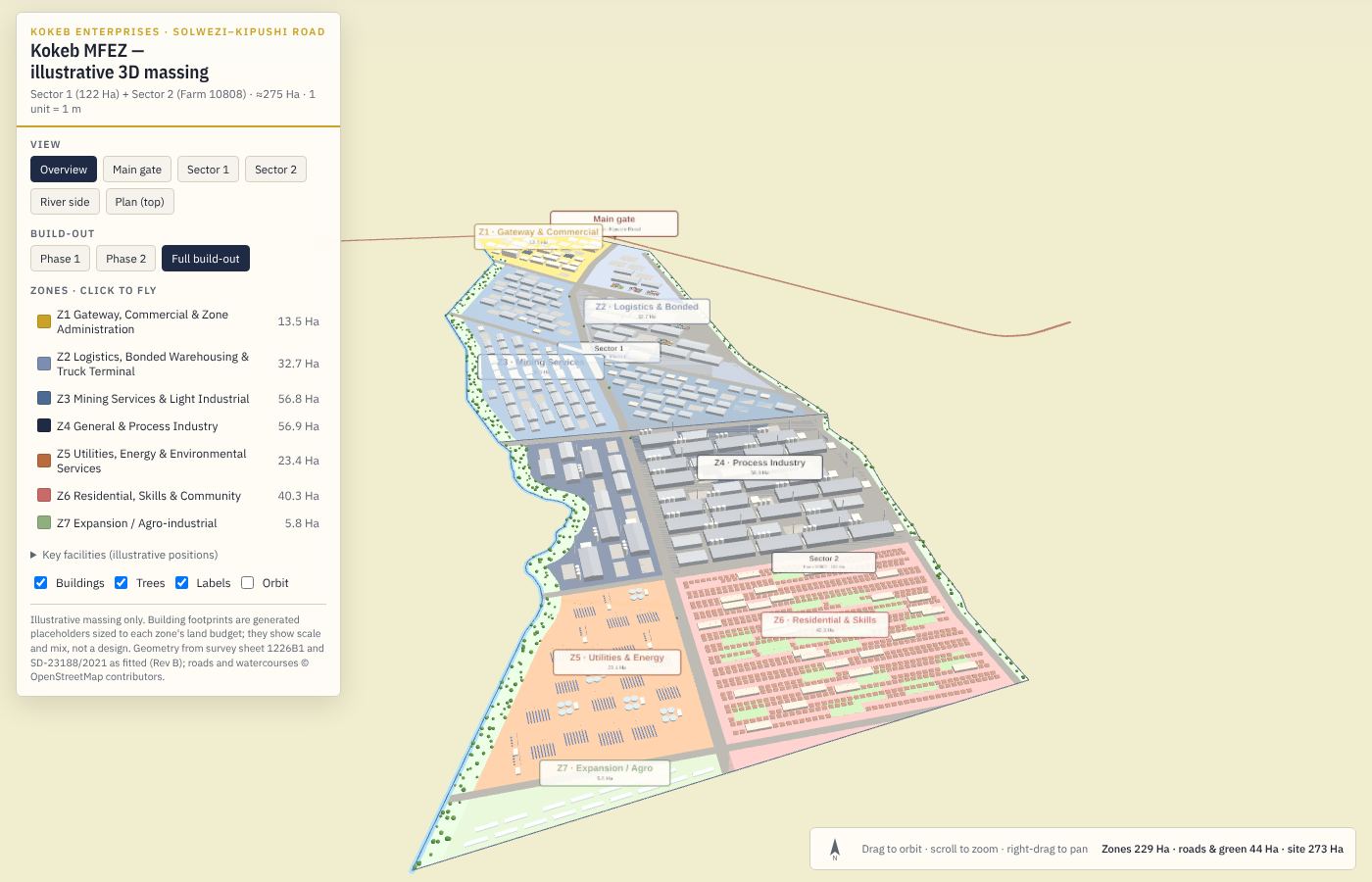
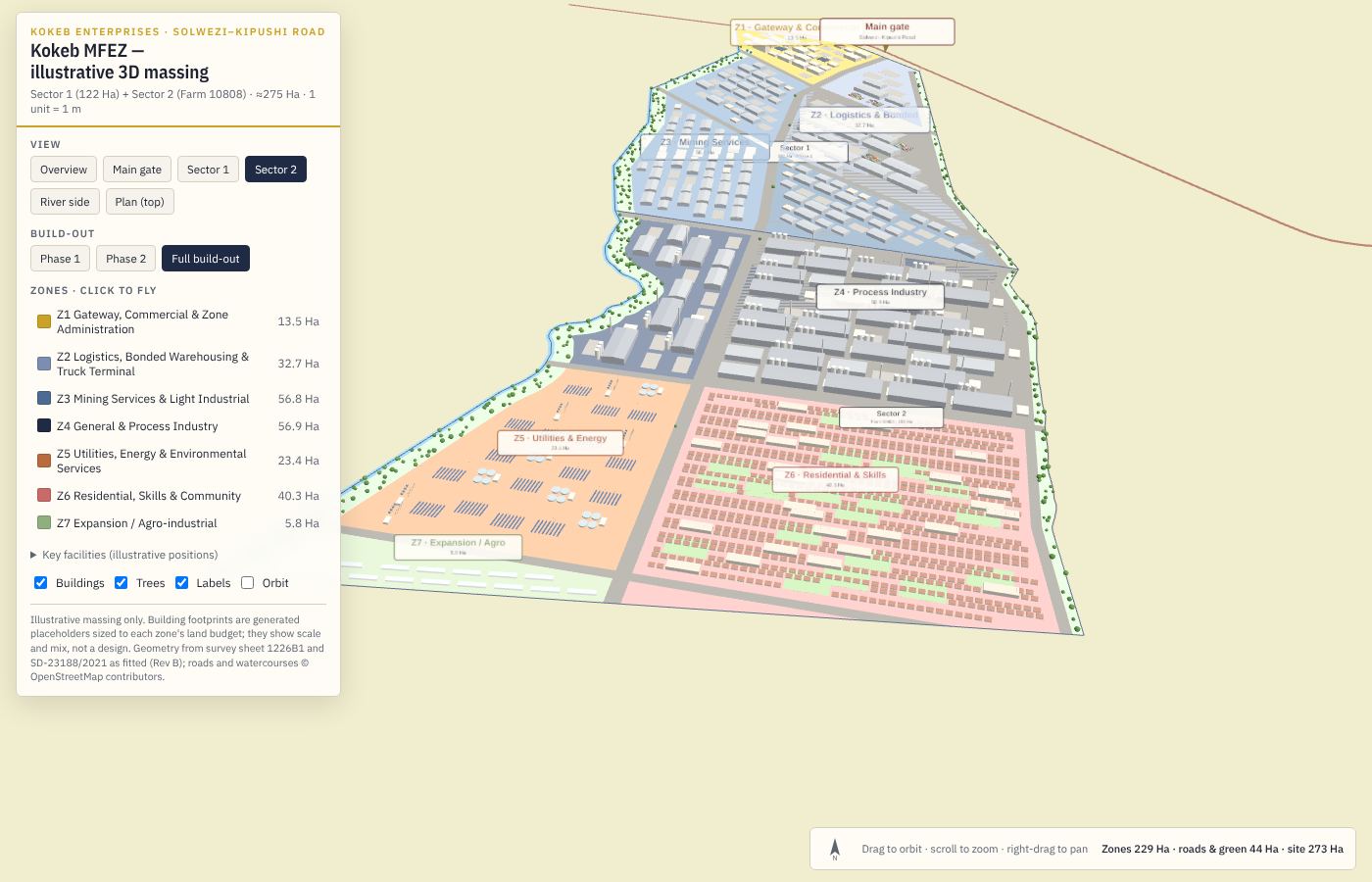
A single formal gateway on the public road clusters the regulatory, commercial and hospitality functions where visitors arrive, so that officials and clients never need to enter the industrial areas. Behind it, heavy-vehicle uses sit in the northern third so that trucks do not traverse the site. A 30-metre spine runs the length of the estate carrying power, water, sewer, fibre and stormwater in one corridor, with 20-metre cross roads forming blocks of 15 to 35 hectares that are subdivided to demand. Industry is graded from light to heavy as one moves away from the gate; process industry and utilities take the river side of the spine, and people take the reserve side, upwind in the prevailing south-easterlies.
| Zone | Use | Intended occupiers | Typical plots | Area |
|---|---|---|---|---|
| Z1 | Gateway, commercial & zone administration | Zone administration and one-stop shop, business hotel and conference, bank, showrooms and offices, retail | 0.2–1 ha; built space to let | 13.5 ha |
| Z2 | Logistics, bonded warehousing & truck terminal | Freight forwarders, bonded operators, container depot, fuel and truck stop, customs examination yard | 1–5 ha; warehouses from 2,500 m² | 32.7 ha |
| Z3 | Mining services & light industrial | OEM service centres, component rebuild, fabrication, consumables warehousing, laboratories, contractor yards | 0.5–3 ha with shared yards | 56.8 ha |
| Z4 | General & process industry | Mineral beneficiation, building materials, agro-processing, assembly and other plants needing heavy power and water | 2–10 ha | 56.9 ha |
| Z5 | Utilities, energy & environmental services | Primary substation, 6–8 MWp solar park, water treatment and storage, wastewater works, waste and recycling | Utility sites; IPP and concession opportunities | 23.4 ha |
| Z6 | Residential, skills & community | Staff and contractor housing, skills academy, clinic, community centre, sports ground, local shops | 500–700 units at build-out | 40.3 ha |
| Z7 | Expansion & agro-industrial | Held for later phases; nursery and compatible agro-industry | — | 5.8 ha |
| Green buffers, river corridor and firebreak | 19.2 ha | |||
| Road reserves (≈11 km of internal roads) | 24.3 ha | |||
| Combined site as drawn | 273.1 ha | |||
Land, buildings, services and a licence to operate
The zone is a serviced estate run by a single developer-operator. Tenants take a plot or a building, connect to shared infrastructure, and deal with one landlord and one administration for everything from power to permits. The offer has four layers, and partners may take any of them.
Serviced industrial plots
Long-term leases of surveyed, fenced plots with road access, power, water, sewer and fibre connections to the boundary. Plots from half a hectare in the light-industrial zone to ten hectares for process industry, with the option to reserve adjoining land for expansion.
- Sizes and road frontage configured to the tenant's layout
- Shared heavy-vehicle yards and parking in Z2 and Z3
- Phase 1 plots on the road frontage available for pre-commitment now
Built-to-suit and ready-built space
Kokeb is an NCC Grade I contractor. We design and build warehouses, workshops, offices and plants to a tenant's specification and lease them back, or deliver standard warehouse and workshop units from 1,000 m² for occupation on short notice.
- Design-and-build under a single contract with the landlord
- Fit-out for OEM service standards: cranes, pits, wash bays, stores
- Serviced offices and showrooms in the gateway buildings
Logistics and bonded services
A customs-licensed bonded warehouse, container depot and truck terminal beside the gate, with a weighbridge, examination yard and fuel and truck stop operated under Kokeb's Novea Energies brand — a staging point for freight to and from the DRC and for the mines' inbound supply.
- Bonded and general storage, open yard and container handling
- Secure overnight truck parking with driver facilities
- Integrated with FreightLink, Kokeb's logistics arm
Zone services and administration
A one-stop shop housing the Zambia Development Agency, Revenue Authority customs, immigration and council functions; estate management, security and maintenance; utilities billed through a single account; and a skills academy aligned to tenants' recruitment needs. The whole estate is administered on Bumuntu Zones, the zone-operations platform developed within the group, so every tenant has a portal and every obligation a record.
- Grid power with a dedicated primary substation, backed by the on-site solar park
- Treated water, sewerage and stormwater management
- Fibre to every plot; housing for staff within walking distance
Incentives for investors in the zone
Once the zone is declared under the Investment, Trade and Business Development Act, 2022, licensed investors within it become eligible for the incentives the Act provides, on the recommendation of the Zambia Development Agency. Eligibility thresholds under the Act start at US$50,000 for Zambian investors and rise to US$1 million for foreign investors, with intermediate tiers for citizen-owned, citizen-empowerment and citizen-influenced companies. Fiscal measures for economic zones announced in recent national budgets include extended relief on export profits and dividends. Kokeb will confirm the precise package with the Agency and the Ministry of Finance as the declaration progresses, and will not quote tenants a figure it cannot stand behind.
What tenants will not have to do
Assemble land, convert tenure, negotiate a road access permit, build a substation, drill boreholes, obtain an effluent licence, or run their own security. The purpose of a zone is to do these once, properly, for everyone. Tenants arrive to a connected plot and a single point of contact, and get on with their business.
Run on Bumuntu Zones, from first enquiry to quarterly return
A zone is only as good as its administration. Kokeb MFEZ will be operated on Bumuntu Zones, the operating software for economic zones and industrial parks that the group developed out of the Bumuntu platform already running its serviced-plot estates in Solwezi. It carries the zone from an investor’s first conversation to the regulator’s quarterly figures in one system, with every change logged, so that what a tenant signed, what they owe and what the zone has reported to the Agency are never three different spreadsheets.
For tenants this means a portal of their own: the lease and its covenants, invoices for premium, ground rent, service charges and utilities, document uploads with expiry tracking, and the investment and employment returns the incentive regime requires — submitted once, to one place. For Kokeb’s zone officers it is the console on which land is allocated by precinct and site, offers become leases and billing runs. For the Zambia Development Agency and other authorities it is a read-only seat showing take-up, capital invested, jobs created, compliance and collections: the transparency a declared zone is expected to provide, and which most zones assemble by hand.
The sectors, zones and plots on this page are already the structure the platform will be configured with, so the first allocation can be recorded the day the first offer is accepted.
Investor pipeline
Every enquiry tracked from first contact to allocation — which is also how expressions of interest from this page will be handled.
Land allocation
The estate managed by sector, zone and plot, with availability, reservations and allocations in one register.
Leases and covenants
An accepted offer becomes a lease with its obligations — build-out deadlines, use restrictions, employment pledges — tracked to completion.
Billing
Premiums, ground rent, service charges and utilities invoiced and collected through one account per tenant.
Regulator reporting
Take-up, capex, jobs, compliance and collections produced as the figures a zone must report, with a live regulator view.
Who we would like to hear from
Kokeb will anchor the first phase with its own operations — the equipment reconditioning and repair workshops, FreightLink, Novea Energies and the construction division — so that the zone opens with activity rather than a signboard. Around that core we are looking for partners of five kinds.
Anchor tenants
Equipment manufacturers and dealers, mining contractors, logistics operators and processors who will commit to Phase 1 plots or built-to-suit facilities. Early anchors shape their plots, secure frontage and set the specification of shared facilities.
Co-developers and equity partners
Investors to join the zone development company that will hold the consolidated title, fund the trunk infrastructure and earn the lease, service and development income across all phases. Structures from a straightforward equity stake to a joint-venture special-purpose vehicle are open for discussion.
Infrastructure partners
An independent power producer for the solar park and substation; a water and wastewater operator; a fibre and data-centre partner; a bonded-warehouse operator. Build-operate-transfer and concession arrangements within the zone are welcome.
Lenders and development finance
Project and corporate lenders, development finance institutions and impact investors for the phased infrastructure programme, with the land, pre-let agreements and Kokeb's own anchor occupation as the basis of the case.
Public institutions
The Zambia Development Agency, the Industrial Development Corporation, Mushindamo Town Council and the provincial administration, with whom the declaration, planning and community programme will be carried through, and who will have a live, read-only regulator view of the zone’s take-up, investment, jobs and compliance from day one.
Housing and social partners
Developers and financiers of affordable housing, a training institution to run the skills academy, and a health provider for the clinic — partners who make the zone a place to live as well as to work.
Three phases that follow the land
The gateway and Sector 1
- Junction with the D271 and main gate
- Zone administration and one-stop shop
- Novea fuel and truck stop; customs yard and first bonded warehouse
- Spine road, boreholes, first substation and fibre
- First mining-services plots, including Kokeb's own workshops
Process industry and utilities
- Boundary Avenue and the spine into Sector 2
- Process-industry plots
- Primary substation, solar park and treatment works
- Business hotel in the gateway
Community and expansion
- Housing, skills academy and community facilities
- Southern cross road and remaining plots
- Expansion land brought into use
Status, November 2026
Land assembled Done
Sector 2 on title; Sector 1 acquired, surveyed and endorsed by the traditional authority.
Concept master plan Done
Zoning, road network, land budget and phasing established; 3D massing and concept note published on this page.
Tenure conversion and consolidation In progress
Conversion of Sector 1 to state leasehold and consolidation of the two parcels into one title through the Ministry of Lands and the Surveyor-General.
MFEZ declaration Pre-application
Engagement with the Zambia Development Agency towards a conditional permit and developer licence under the Investment, Trade and Business Development Act, 2022.
Surveys, planning and ESIA Scheduled
Topographic, flood-line and geotechnical surveys; statutory layout plan with Mushindamo Town Council; environmental and social impact assessment with ZEMA; road-access, power and water permits.
Anchor commitments and Phase 1 works Open
Pre-commitments from anchor tenants and partners inform the final Phase 1 layout and trigger the infrastructure programme.
Kokeb Enterprises Limited
Kokeb is a Zambian group headquartered in Lusaka with its operational base in Solwezi. Its construction division holds the National Council for Construction's Grade I registration and has delivered industrial, commercial and institutional projects for multinational clients, including the US$8.5 million British American Tobacco facility in Lusaka. Around construction the group has built businesses in property development, equipment reconditioning and repair, energy and fuel under the Novea brand, logistics under FreightLink, payments under Kokeb Pay, quarrying and critical minerals, and technology.
The zone draws on all of them. Kokeb will be the developer, the contractor, the estate manager and the first tenant — which is also the clearest signal we can give partners that we intend to be here for the long term.
Download the concept pack
All plans, renderings and figures on this page are concept-stage and illustrative. Zone boundaries, building footprints and areas are indicative and subject to survey, statutory approvals and the declaration of the zone. Nothing here constitutes an offer of securities or a binding commitment to lease.
Talk to us about a plot, a building or a partnership
Tell us who you are, what you do and roughly how much land or floor space you would need, and we will come back to you with the relevant part of the plan, the status of the approvals and a proposal for how we might work together. We are equally glad to hear from institutions and advisers who want to understand the project.
Site visits can be arranged from our Solwezi office, which is about forty minutes from the gate.
Kokeb Enterprises Limited
- info@kokebenterprises.com
- Phone
- +260 97 409 4000
- Solwezi
- Stand No. 7745, Kansanshi Road, Solwezi
- Lusaka
- Plot 610/4AA, Zambezi Road, Foxdale, Lusaka
- Web
- www.kokebenterprises.com
- Kokeb Enterprises Limited